
How to apply this guide
How track conditions add context to a result, and why one label cannot explain an entire performance.
Read race distances and winning margins alongside the going description. The racing archive links to individual records with race conditions where supplied.
A description of the racing surface
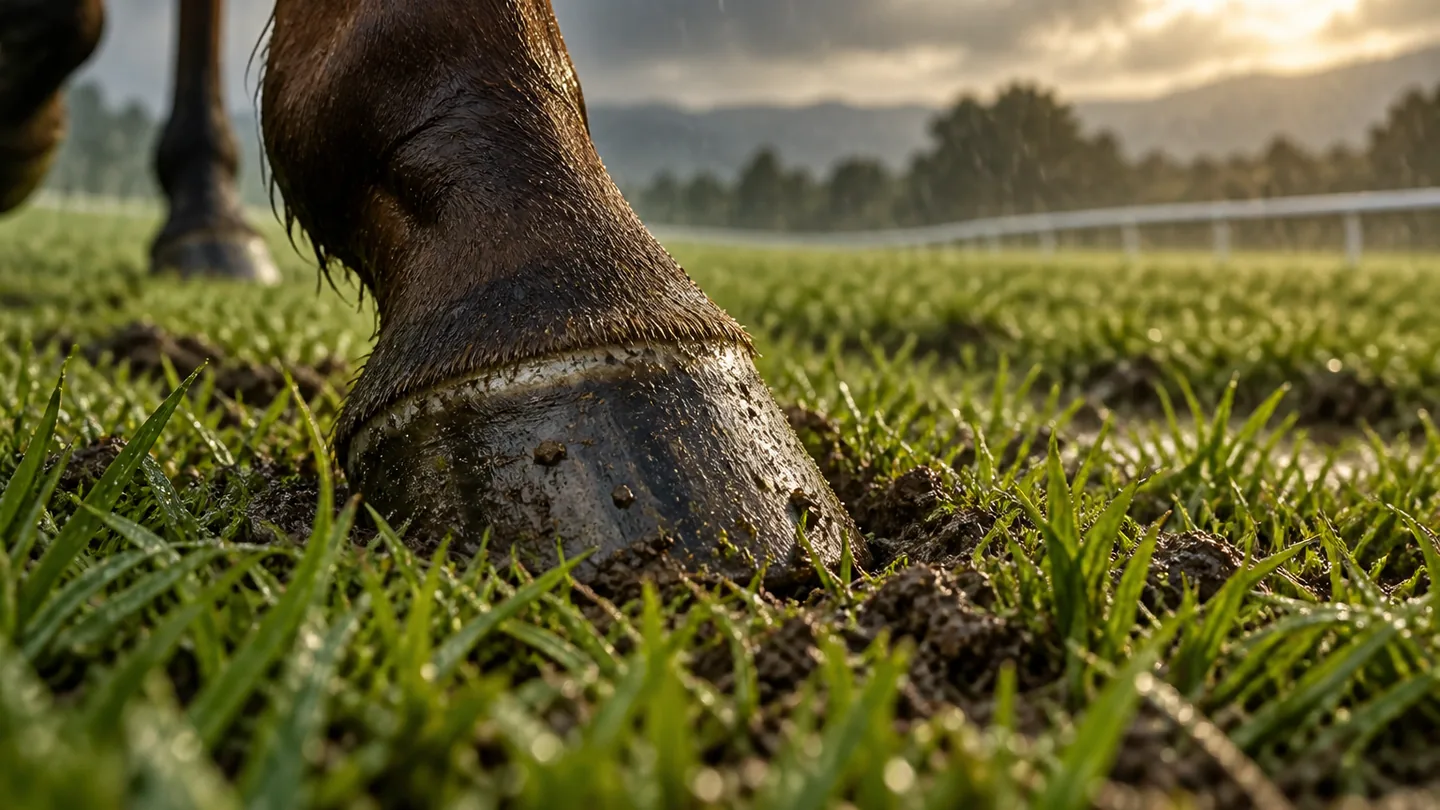
The going describes the condition of the ground. On turf, familiar descriptions range from firmer to softer conditions. An all-weather surface uses its own reporting conventions, so do not treat a synthetic-surface label as interchangeable with a turf label.
The published description gives context for the race. It is not a measurement of how every individual horse will perform.
Why conditions can change during a meeting
Rain, drying weather and course maintenance can alter conditions. Different sections of a course can also be described differently. A report may include a main label with qualifications for particular areas.
For an archived result, use the going attached to the race or meeting at the time. Today’s course description does not explain a race run there last month.
What the going can and cannot tell you
Surface conditions can help explain why times vary, but pace, distance, race type and the horses involved also matter. A slower winning time does not by itself prove a lower-quality performance.
Avoid drawing a complete conclusion from one label. Read the distance, field and finishing margins alongside it, and distinguish reported conditions from an observer’s personal impression.
Reading an incomplete record
If going information is missing, treat it as unavailable. Guessing from a weather forecast is unreliable: rainfall at a nearby station is not a racecourse’s official surface assessment.
Results.fast keeps missing fields explicit. That allows you to compare records knowing which details are present and which need independent confirmation.
Read the qualification as well as the main description
A report such as “Good, softer in places” communicates variation. Reducing it to “Good” removes information about parts of the course. Where both an overall description and a more detailed note are supplied, keep them together when reviewing the result.
The report is also tied to a time. Conditions recorded before the first race may not describe the last race after a change in weather. For an archive comparison, the relevant evidence is the event’s reported condition, not the current racecourse page or a general weather summary.
Why a going report does not explain everything
A slower race can result from several interacting factors, including the pace and the course configuration. Going is useful context, but it is not a complete explanation of a finishing time or margin. Avoid treating a label as a formula that predicts how many seconds a horse should gain or lose.
A more useful comparison records what is known: race type, full distance, going, surface, field and result. It also records what is missing. If detailed sectionals or timing conventions are unavailable, say so rather than deriving a precise performance claim from one condition label.
Reading surface information
| Reported information | What to retain | What not to assume |
|---|---|---|
| Turf going | The full condition description. | That all parts of the course are identical. |
| “In places” qualification | The qualification alongside the main label. | That it can be discarded as decoration. |
| All-weather surface | The actual surface and reported condition. | That “standard” means the same as good turf. |
| Updated report | Its time and affected event. | That it applies to every earlier race. |
| Missing going | An explicit unavailable value. | A substitute based on a nearby weather forecast. |
Two races at the same course
Suppose a morning report describes the going as good and a later report adds a softer qualification after rain. A result recorded earlier in the meeting should keep the information associated with that event. Automatically replacing every old record with the newest course label would make the archive less useful. The same principle applies across seasons: a current going report belongs to current racing and cannot be used to explain a performance at that course several months ago.
A practical reading checklist
- Identify the surface first.
- Read the whole going description.
- Check which race or meeting the report covers.
- Treat going as context, not a complete performance rating.
For unfamiliar terms, use the racing and football glossary alongside the result.
Common questions
Does an all-weather track always have the same conditions?
No. The name describes the type of racing surface, not a guarantee that every meeting has identical conditions. Retain the provider’s surface and condition fields.
Why is the going blank on some results?
The provider may not supply it for that record or subscription. A blank value should remain unavailable rather than being filled using an assumption.
Sources and further reference
Examples in this guide explain how to read a record; they are not reports of actual events. Competition-specific rules and the provider’s field definitions take priority for a particular result.